
The Era of Tabulation
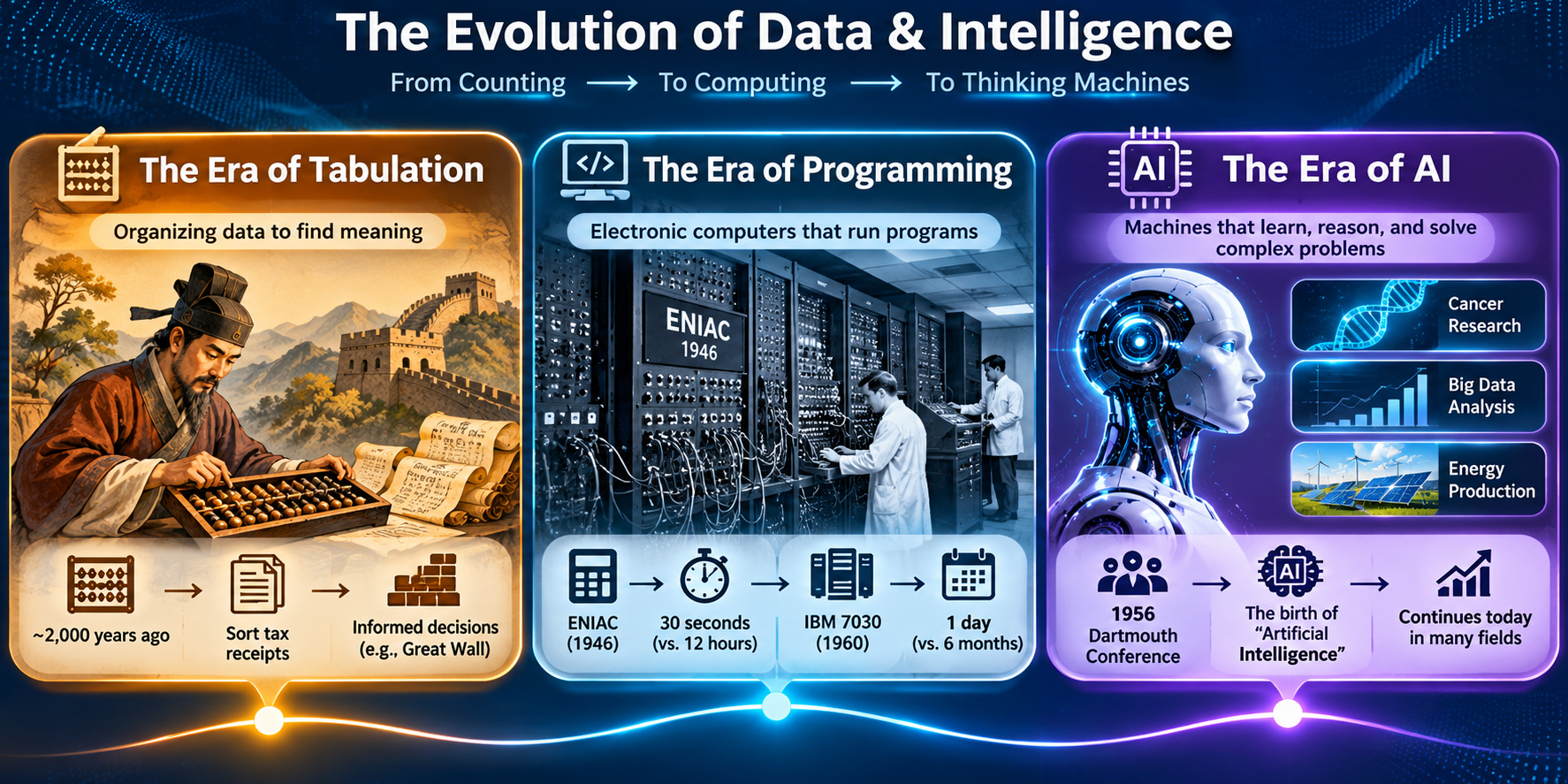
The Era of Tabulation introduced the use of machines to structure data and reveal hidden insights. For centuries, humans struggled to extract meaning from large amounts of unstructured (images, audio, text) data. To organize data, humans began developing machines. For example, over 2,000 years ago, Chinese tax collectors used the abacus to sort tax receipts, which aided their decisions on the construction of the Great Wall.
The Era of Programming
The Era of Programming marked a breakthrough in data processing as scientists developed electronic computers that could run multiple instructions or “programs”. In 1946, the University of Pennsylvania introduced the revolutionary Electronic Numerical Integrator and Computer (ENIAC). The applications for ENIAC included atomic energy calculations, ballistics, random number studies, thermal ignition, weather forecasts, and wind tunnel design. ENIAC could perform calculations in 30 seconds that previously took 12 hours using handheld calculators. In 1960, IBM introduced their first supercomputer, the IBM 7030. The IBM 7030 performed calculations in one day that took even the world’s fastest computers six months to solve! Today, the Era of Programming continues, with applications ranging from smartphones to space exploration, all powered by computer programming.
The Era of AI
The Era of AI began in 1956 when John McCarthy and Marvin Minsky, along with a small group of researchers, coined the term “artificial intelligence” at Dartmouth College. They proposed that machines could simulate human learning and intelligence. By the mid-1990s, advances in computing power enabled machines to solve more complex problems. Today, the Era of AI continues, with AI facilitating advancements in fields including cancer research, big data analysis, and energy production.
Discussion
No replies yet. Start a thoughtful conversation.